Consultation
You will first meet with one of our surgeons for an exam and digital X-rays, which give us a 360-degree view with less radiation. Your surgeon will review your medical history, answer your questions, and plan any preparatory care.

Surgical Specialists Restoring Smiles
Our father-and-son team treats patients throughout Logan, Garland, and all of Cache Valley. Dr. Nate Anderson finished an oral surgery residency at Vanderbilt University Medical Center. His father, Dr. Greg Anderson, is board certified in oral and maxillofacial surgery.
Dental implant placement can cause feelings of anxiety. To keep you calm and pain-free throughout your treatment, we can pair local anesthesia with nitrous oxide, IV sedation, or general anesthesia.
Our accessible offices welcome patients of all ages and abilities, including children, seniors, and people with disabilities. Dr. Greg Anderson speaks English, Spanish, and Portuguese, and our friendly team is happy to answer questions.
Because implant placement involves surgery, it pays to have a surgical specialist in charge of your procedure. An oral surgeon completes additional years of training after dental school. Rebuilding bone, removing damaged teeth, and placing implants are core parts of that specialty. When you choose our oral and maxillofacial surgeon in Logan, UT, you get a team that welcomes complex and emergency cases and offers a full range of sedation options.
Dr. Nate studied dental medicine at the University of Nevada, Las Vegas. He then completed his oral and maxillofacial surgery residency at Vanderbilt University Medical Center in Nashville, Tennessee. Patients appreciate his calm manner, clear communication, and attentive care.
Dr. Greg earned his dental degree magna cum laude from the Medical College of Virginia School of Dentistry. He holds privileges at Logan Regional Hospital, Cache Valley Hospital, Bear River Valley Hospital, and Brigham City Community Hospital.
At Mountain West Oral & Facial Surgery, a single implant starts at $1,200, with $400 due at the time of service. To help make implant care a fit for your budget, we accept:
We accept Medicaid and most major insurance plans. Dental implants are not typically covered by insurance, but your crown, bridge, denture, and preparatory work may be. We will work directly with your insurance company to maximize your benefits.
We accept third-party financing to help you pay any out-of-pocket expenses over time. We take plans from CareCredit® and Cherry, healthcare financing companies with short-term payment plans that have little to no interest.
Dental implants can restore any degree of tooth loss. Here’s how it works:
A single implant supports one custom crown that’s color-matched to your teeth and designed to blend in seamlessly with your smile.
Larger gaps in your smile from a few consecutive missing teeth can be restored with two implants and an implant-supported bridge.
An implant-supported denture rests on several implants anchored in your jaw, giving it stable support when you eat and speak.
A dental implant replaces lost tooth roots. Your oral surgeon places the implant in your jawbone, and over several months, the bone grows tightly around it. This bonding process is called osseointegration. Once the implant is secure, it can hold a crown, bridge, or denture that looks and functions like a natural tooth.
Implants protect your jaw, too. After a tooth falls out or is extracted, the bone around it can start to atrophy. Because the implant mimics a natural root, it keeps stimulating your jaw, which helps the bone stay healthy.
If your jaw is too weak or thin to support an implant, our oral surgeons may be able to strengthen it and prepare it for surgery.
Bone grafting adds biocompatible material to areas of the jawbone that have atrophied. The graft gradually integrates with your natural bone, and implant placement usually follows about four months later. In some cases, we can remove a failing tooth and graft the site during the same procedure to prepare you for an implant.
Upper molars and premolars sit just below the sinus. When bone in that area atrophies, the sinuses can lower and make implant placement more difficult. A sinus lift adds bone grafting material to the upper jaw and raises the sinus. Healing often takes about four months, though some patients need up to a year before an implant can be placed.
Locations
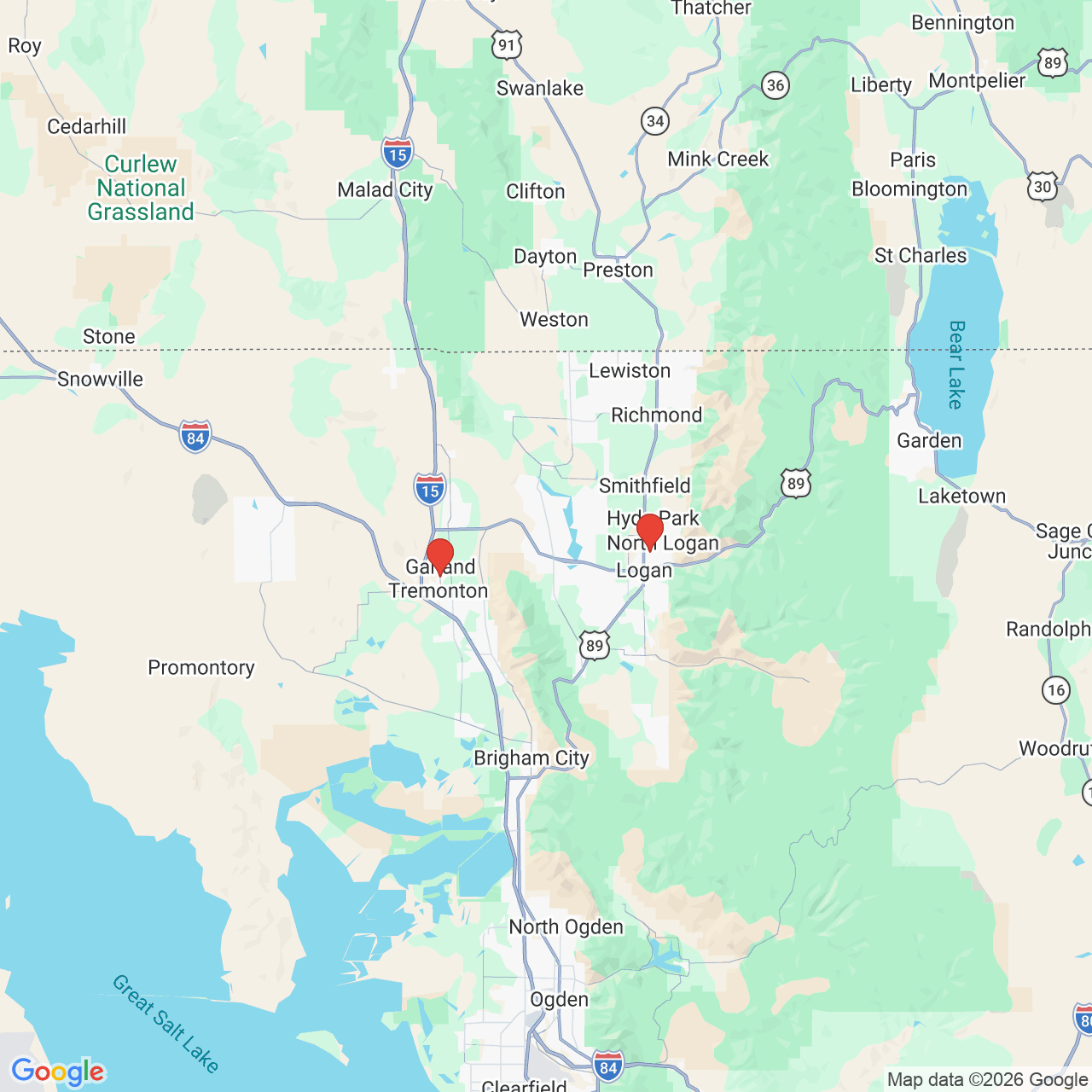
We have 2 locations Utah. One in Logan and the other in Garland.